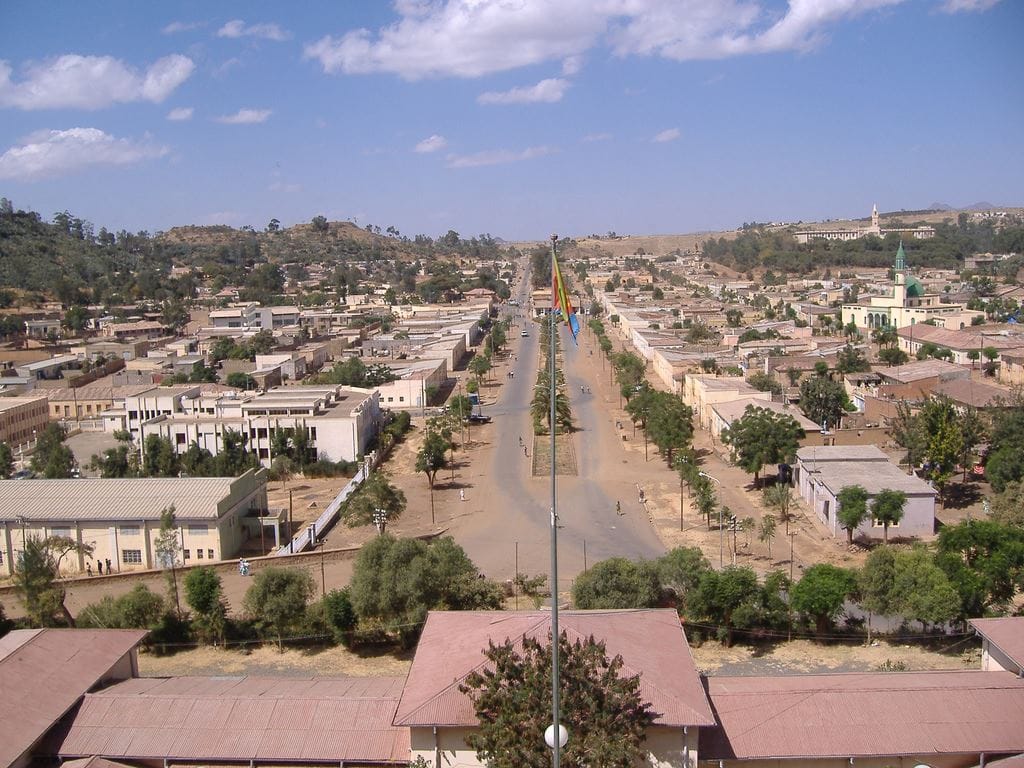
Post-war rehabilitation of the Ursuline Sisters’ schools in Adigrat and Wukro to resume educational activities
D.1.4. Food insecurity
Widespread lack of access to food is due to conflict in Tigray Region, drought conditions in southeastern areas, high food prices. The difficult and worsening food security situation is the result of multiple shocks affecting food availability and access including: the conflict and post conflict in Tigray Region and in adjacent areas of Amhara, Oromo and Afar regions, which began in November 2020. In Tigray region alone, 5.3 million people are estimated to be severely food insecure; the failure of the MarchMay 2022 “GuGenna” rains in southern pastoral areas of southern Oromiya Region and southern Somali Region, exacerbated drought conditions prevailing since late 2020, causing severe crop and livestock losses; severe macroeconomic challenges including insufficient foreign currency reserves and the continuous depreciation of the national currency, as a result, inflation is at very high levels, with the yearonyear food inflation rate estimated at 35.5 percent in July, one the highest of the last decade; these difficulties are exacerbated by the ripple effects of the Ukraine war, which triggered hikes in international prices of wheat, fuel, and fertilizers.
A tangible sign of the financial difficulties of the country is the devaluation of Birr, local currency:
| DATE | Exhange € / Birr | DATE | Exhange € / Birr |
| 01/01/2013 | 23,8347 | 01/01/2022 | 55,6768 |
| 01/01/2014 | 25,9827 | 01/01/2023 | 57,0225 |
| 01/01/2015 | 24,2872 | 01/01/2024 | 61,9055 |
| 01/01/2016 | 22,8357 | 30/06/2024 | 61,5733 |
| 01/01/2017 | 23,3844 | 01/08/2024 | 68,0732 |
| 05/01/2018 | 32,5663 | 10/08/2024 | 105,017 |
| 01/01/1900 | 31,9847 | 31/08/2024 | 119,979 |
| 01/01/2020 | 35,4934 | 30/09/2024 | 130,165 |
| 01/01/2021 | 47,5553 | 01/12/2024 | 130,454 |
It is evident that after a period of relative stability and growth, immediately after the death of the Prime Minister Melles Zenawy who led the county from 1991 up to 2012, social tension obliged his successor Hailemariam to resign on 2018. The political new course heightened the internal tensions which culminated with internal war in 2020. Despite the peace agreement with Tigray, unrest, ethnic clashes and fighting with the federal army are still alive, impeding free movement, commerce and undermining the simple normal agricultural and economic activities.
E.Local Situation:
E.1. Civil war
In November 2020, a military conflict erupted between forces aligned with the Tigrayan People’s Liberation Front (TPLF) and Ethiopia’s national army, the Ethiopian National Defense Force. With the Eritrean intervention the conflict become immediately international. The conflict continued throughout 2021, has exacerbated ethnic violence and has largely centered in Tigray, Amhara, and Afar regional states. Today the conflict is far from over and the insecurity and violence has expanded to most of the regions. International Agencies say that:
“The world’s largest humanitarian disaster, with 9.3 million people affected in the Tigray, Amhara and Afar regions, is underway. More than 1.6 million women and children in Tigray, 1.4 million in the Amhara region and 80,000 in the Afar region, are in need of preventive assistance for malnutrition. In the Tigray region alone, 667,000 pregnant or lactating women and children present symptoms of hunger and malnutrition and need immediate assistance”. (Focus on Africa, 2022)
The recent attack to Muslim during a funeral in Gondar is another serious and dangerous sign of the growing unrest that could also take the color of religious confrontation.
“The Addis Abeba Islamic Affairs High Council said in a statement early April 28 that the number of people killed in Gonder town on April 26 had risen to 21 and that the attack was a “planned massacre.” The Council also said mosques and Qur’ans were burned, women were raped, and properties belonging to Muslims in the town destroyed…. The Council further blamed the government, the Amhara state media, and some political party leaders for their statements which failed to depict the “barbaric acts committed” by these “extremists” and added that “the Muslim community is deeply saddened by the attempt to portray the crimes that claimed the lives of 21 Muslims as is if it was civil strife caused by a border dispute to cover up for those who want to destroy the country.” The council demanded that the government clearly state the severity of the damage and bring the perpetrators to justice”. ( The Ethiopia Cable – N. 076 – April 25-27 /2022)
E.2. Tigray socio-economic and political conditions
The current socio-economic and political condition of Tigray has largely been shaped by the effect of the recent two-year war waged on the region by the Federal government of Ethiopia, supported by hundreds of thousands of special forces and militias of other regions of Ethiopia, and the entire military forces from the State of Eritrea.
The war that waged on Tigray, in the pretext of maintaining rule and order, actually turned out to have taken a brutal course, indiscriminately targeting the whole people in the region. The two year war, November 2020 to November 2022, has been considered as one carried out with the intent of carrying out genocide on Tigray people. During the two years:
•About one million people in Tigray has lost their lives,
•Nearly two million internally displaced from their homes, and these are largely remain in dire condition, unable to return to their home villages though it was expected that they will be back to their places following the purported peace deal signed between the Federal government of Ethiopia and the Tigray Region Authorities.
•More than fifty thousand people fled to Sudan as refugees from Western Tigray and today they are trying to come back due to the war in Sudan;
•One-hundred and twenty-two thousand women subjected to rape, gang rape, and various forms of Gender Based Violence,
•Due to total blockade of the region, land and air, tens of thousands of people have lost their lives, for lack of food (starvation used as a weapon of war) and medicines/medical services,
•The whole inhabitants of Tigray have been carrying various forms of psychosocial trauma,
•The entire economy of the region was crashed, factories, small business establishments, livestock, etc., looted and destroyed; and the region went through sever economic crisis during the two years; millions of people are still in a state of starvation yet.
•Limited Access to Education: The conflict has significantly limited access to education in the Tigray region. With damaged schools materials displacement and looting, instability, many children are unable to attend schools or receive any form of education for last two and half years, and in some areas schools are still closed.
The post war condition in Tigray, the period running since the signing of peace agreement in Pretoria, South Africa in November 2022, continues to bear multiples socio-economic and political challenge for the entire people in the Region.
The displaced people from West Tigray, areas that borders Eritrea in the Eastern and Central Tigray are livening in IDP camps, in urban areas such as Mekelle and Adigrat. These people are living in dire situation. There are areas of Tigray under occupation of Amhara forces (West Tigray) and Eritrean army (parts of Eastern and Central Zones of Tigray). For as long as these forces are there, it will be nearly impossible for the IDPs to get back to the occupied home villages. As a result of these, war and insecurity is going on all over the country and continue to put the prospect of socio-economic recovery and stability of Tigray as well as the entire country in a fragile situation. Humanitarian crisis is affecting millions of people in Tigray and other parts of Ethiopia.
Focusing again on Tigray context, the livelihood of the people crushed during the two year war, people are unable to economically rebuild their lives. Consequently, for example, youth in large numbers are migrating to the Middle East countries and to Europe, through dangerous paths, falling victims to human traffickers who ask huge ramson to get them proceed along the illegal migration channels; on the way many have lost their lives! School children, having been forced out of education for about four(4)years—initially in the year before the outbreak of the Tigray war due to COVID-19 closure of schools, and then by the war—have lost hope in education, in their future life here in their homes in general, thus are joining those youth illegally out migrating from all over Tigray.
E.3. Education in Tigray
Even though school resumed functioning after six some months following the Pretoria peace agreement, the quality of education all over Tigray has turned out to be discouraging, to parents and the students alike:
•Students are made to take crash courses, to make up for lost years—i.e., according to the Tigray Region Education Bureau, one year courses are given in four-five months, meaning that within one semester they are going through a one year courses that used to take ten months in normal years. Though this arrangement goes on compensating for lost school years, students are not getting proper education, one of the reasons for their loss of hope in doing well in their education,
•About 90% of schools in Tigray were totally or partially destroyed and looted of their property, as a consequence many schools could not reopen and those that did are heavily hampered by the physical condition of the building and lack of basic furniture and equipment.
•Functioning schools such as the primary school of Ursuline sisters in Adigrat and Wukro have to cater for far more students than the capacity of their school normally permits. Accommodating students in such a crowded condition contributes to poor quality education, which is the case in all schools all over Tigray.
•The effect of psychosocial trauma on school children is enormous, as this is evident in the conduct of character of students, and the youth, at schools and within the broader social context—managing students at school is difficult, there are growing use of drug and alcohol abuse; violence, theft, gang robbery have become a normal daily occurrence everywhere in urban areas, including to considerable extent in rural settings as well.
Socio-economic recovery of Tigray, including revitalization of education services, is an enormous challenge to this day; and the recovery effort needs the involvement of multiple actors—the regional government and the Federal government of Ethiopia, civil society organizations, religious organizations, etc.,–including the local entities. The support of external humanitarian organizations is critically required for the rehabilitation/recovery of lives and livelihoods of Tigray.
E.4. War impact on Ursuline Sisters’ mission in Wukro and Adigrat
The Tigray region has been blockaded for two and a half years, devastating health, education and the social fabric. In our school, for example, the deputy headmaster died from lack of medicine, four school children died from artillery sent indiscriminately. For this reason, the Sisters opened the school doors to the refugees. The schools then served as a refuge for more than 3,226: mothers with children and elderly unable to escape the city during the bombing. The the Sisters’ residence was one of those affected by the bombings. In the midst of the conflict, a traumatic event occurred when a rocket hit the sisters’ rented house. These particular incidents are a microcosm of the horrors experienced by the people of Tigray. The nuns, who had taken refuge in their house, miraculously survived, defying the odds in the face of unimaginable danger.. However, when they ran into the neighbourhood, they were severely shaken by the traumatic event. At the same time, their survival is a testimony to the strength and resilience of the human spirit and the goodness of God.
Adigrat and Wukro suffered not only the domnages and distruction due to shelling and active fighting, but also for repe
As part of their mission, the Ursuline Sisters in Wukro and Adigrat town, has developed this project proposal seeking the financial assistance from charity organizations to contribute towards the much needed effort of education service recovery in the war-torn region of Tigray, targeting the Kindergarten & primary school the congregation has been running in Adigat town, two Kindergarten and one Elementary school that has been providing basic, formal education for about two thousand students annually enrolled in KG 522 students and grade1- 8 from 1552 students
The school, though, has been facing critical challenges; and addressing these are the purpose of this project—as details will be explained in the following sections of the document.
F.Project Description and Goals:
F.1. Introduction
The goal of the project is to get the educational activities of the two Ursuline Sisters’ schools in Adrigrat and Wukro back on track. We believe it is illuminating to report two brief accounts of the first months of the war in the area to which the project refers:
“Our second virus (note: we were during the COVID pandemic) is the situation in our country that in these situations those who always lose out are the poor, the weak children and women. We as Ursulines have two communities in the NORTH, Wukro and Adigrat, of which we had no news for almost two months, because they have no light, no water and no communication. Finally after one month and three weeks on 16/12/2020 (note: the war stated on November) we got the good news that the Sisters are safe, but the soldiers took away the car, all the computers and anything transportable from the primary schools and the kindergarten. We do not know more because there is no communication and the Sister had to go, by makeshift means, to Mekelle (50km) to phone us, and on the same day had to go back. However, we thank the Lord that the Sisters are safe because in Wurko there were three days of fighting and many lost not only their belongings but also their lives”.
“It is not easy to describe the situation of our people. There are few families who have not been touched in the flesh. 4 grandchildren of Sr.Lemlem Zigta with 10 other young men in the same village, 2 grandchildren of Sr.Tihesh Berhe with 9 other young men in his village were killed. They take away from the houses everything they can find: wheat, children’s and adults’ clothes, pots, pans where they bake the bread, glasses… After they have taken away everything they can, they set fire to the houses so that those who ran away on the way back will not even find their houses. Sr. Tihesh’s brother had a car with which he used to take food from the city to the villages, wheat, coffee, berbere…. they took it away from him, it was his only source of livelihood, and we thank the Lord that they did not kill him. These soldiers say they have orders to kill all males over the age of six, because tomorrow when they grow up they can take revenge.
Tigray for this moment is really difficult. In Tigray they fought, both the federal soldiers of Ethiopia and those of Eritrea. They took away everything they could from both the government and private individuals, especially cars. As many as 200 ambulances were taken away from all the hospitals and private clinics, often killing the drivers who brought the sick and women in labour to the hospital. They drop off women in labour wherever they are on the street so that the mothers with the baby, leave for eternity . They take everything out of the hospital leaving only the walls that they cannot dismantle. In one village (Hausen) they killed 50 young women because they told them to bring their husbands, and they did not know where they were. People displaced from their villages are starving, they have no food, and even if they find something they have nowhere to cook, because their houses are occupied by soldiers or have been destroyed.
From our community in Wukro they took away the car, the school computers and everything that was transportable. These days they came again at night, invaded the whole compound, tied up the guards, locked the nuns in a room, and raped two little girls under the age of 15. They searched all the rooms, took away all the nuns’ mobile phones, the watches they were holding, the portable computers.
So we strive to say with Job, ‘The Lord gave, The Lord took away. Blessed be the Name of the Lord’ (Job:1-22)
The situation is not easy, but with God’s grace one can accept everything and live in peace, and we try to console the affected families with prayer and encouragement. We rely on your prayers”.
F.2. Rationale of the Project
F.2.1. General Objective
Improving quality education service provision for students from economically disadvantaged families in Adigrat and Wukro towns and the surrounding rural areas. In this post-war period, the period in which Tigray’s schools has been left severely destroyed, hundreds of thousands passed through nearly four years without access to education, schools operated by the Church and the catholic religious congregations are expected from the communities served to stay functional, putting every effort to improve quality education for tens of thousands of students, contributing toward the overall recovery of education in the war-torn Tigray.
The statistics of the three kindergartens and two elementary schools in the towns of Adigrat and Wukro are:
| Description | KINDERGARTEN | PRIMARY | TOTAL | |||||||
| n. classes | M | F | Total | n. classes | M | F | Total | Classes | People | |
| Adigrat | ||||||||||
| Personnel | 9 | 7 | 26 | 33 | 29 | 32 | 39 | 71 | 38 | 104 |
| Students | 262 | 260 | 522 | 772 | 786 | 1.558 | 2.080 | |||
| Wukro | ||||||||||
| Personnel | 11 | 4 | 38 | 42 | 13 | 18 | 13 | 31 | 24 | 73 |
| Students | 372 | 364 | 736 | 297 | 289 | 586 | 1.322 | |||
| TOTAL | ||||||||||
| Personnel | 20 | 11 | 64 | 75 | 42 | 50 | 52 | 102 | 62 | 177 |
| Students | 634 | 624 | 1.258 | 1.069 | 1.075 | 2.144 | 3.402 | |||
It is striking that there is a nearly perfect balance between male and female students and personnel, with the understandable predominance of female in the kindergartens.
F.2.2. Specific goals
The pressing concern is to address the post-war challenges at St. Angela Adigrat and St. Joseph Wukro schools so to allow the full resumption of the educational activities, being aware that some of the building were damaged by explosions and that schools and communities were looted, “they took away the car, the school computers and everything that was transportable”. (Sr Abeba’s report)
Considering that the number of students requesting to be enrolled in the two schools is increasing by day, due not only to the quality education offered, but also to the fact that many schools are unable to reopen and if they do, they lack of most of the basic requirements, tree priority needs emerge:
•Trauma healing action
•Equipping classrooms with new furniture: student desk, staff tables, chairs, file cabinets, etc..
•Equipping the schools with new computers, projectors, photocopier… an for the water, solar pumps and photovoltaic panels…
•Maintain existing school building especially the WASH facilities.
SUBPROJECT – Trauma healing
The Tigray war was an armed conflict that lasted from 3 November 2020 to 3 November 2022. It was a civil war that was primarily fought in the Tigray Region of Ethiopia between forces allied to the Ethiopian federal government (ENDF, EDF) and Eritrea on one side, and the Tigray People’s Liberation Front (TPLF) on the other.
“The latest report from the International Commission of Human Rights Experts on Ethiopia documents atrocities perpetrated “by all parties to the conflict”, particularly the ENDF, EDF, Amhara forces and TDF, committed war crimes during the conflict. Mass extrajudicial killings of civilians took, between 162,000 and 600,000 people were killed, and war rape became a “daily” occurrence, with girls as young as 8 and women as old as 72 being raped, often in front of their families. A major humanitarian crisis developed as a result of the war, which led to a widespread famine. It also inflicted immense economic damage on the region, with the cost of rebuilding alone estimated to be roughly $20 billion.
International Commission of Human Rights Report, 2022
Rehabilitation and recovery of the living conditions of the Tigray people requires urgent, integrated support services. It is obvious that responding to intricate challenges affecting the lives of the people cannot be addressed with small project interventions such as this one. Nevertheless, the Catholic Church in the Diocese of Adigrat, believes that small efforts here and there, combined, will give hope to some people, gradually contributing to the general psychosocial and livelihood recovery of the communities at large. With this in mind, the goal of this project is to provide psychosocial support, combined with spiritual formation, to women, children and adolescents.
F.2.2.1. Rehabilitation of Ursuline Sisters’ schools in Wukro and Adigrat
F.2.2.1.1. Furniture and equipment
School furniture, notably, classroom desk-table for students and teachers, requires replacement because stolen and/or damaged beyond repair. On top of this students catered at the St. Anagela and St. Jospeh, as for most of educational and health facilities in the whole Tigray, were out of school for nearly four years, due to Covid, then by the war. When they had to start education again after the signing of peace agreement, they were three to four years older to their normal class age. The surviving desks-tables do not fit to the students’ physical growth. A summary of the needs:
| Furniture and Equipment needs for Adigrat & Wukro | |||||||||||||||
| student’s benches | chairs | Blackboards | teachers’ table | computer desks | shelves | Steel cupboards | Filling cabinet | Office desks | Office chairs | computer | Printer | Photocopier | Projector | Photovoltaic system | Solar pumps |
| 600 | 16 | 8 | 32 | 26 | 20 | 22 | 27 | 22 | 24 | 39 | 7 | 3 | 5 | 54 | 2 |
F.2.2.1.2. Maintenance work
The school infrastructures were built on late ninety and since no substantial maintenance was done, consequently they were already presenting some deterioration before the war. During the two years of war several heavy artillery shells landed in the compound and in the vicinities of the school, the heavy explosions contributed to the deterioration of the building, creating new cracks and extending the existing ones. Their conditions does not favor a good education environment and dome time they represent a real hazard for the students and teachers. The following actions are needed:
•Rebuilt the sanitary facilities,
•Plastering of cracked walls,
•Maintaining deteriorated floors,
•Maintaining deteriorated roofs,
•Maintenance of damaged doors and windows,
•Fixing electricity system
F.2.2.1. 3. Water and electricity
The town water supply and electric system in Adigrat have been seriously damaged by the war. The water supply is becoming more and more scarce and unpredictable. The school has been facing critical water shortage not only for hygienic purposes but even for drinking, thus it is very difficult to keep decently clean toilets and classrooms, this is affecting the school sanitation. The electricity in not constant, it is available only for few hours in turn among the different town’s zones and for few hours.
St. Angela school in Adigrat has deep a drilled well but not exploitable because of the erratic availability of electric power and, also when it is available, the tension is too low for our pump to function.
To solve the water problem we propose to install:
•Install a photovoltaic system and fixing the electric system,
•Install a solar pump in the well,
•Renew the pipe lines for water distribution,
•Install three plastic water containers of 10,000 liters in which to store water throughout the day.
F.3. Specific Results (SR):
•SR #1: Psychosocial recovery counseling services are provided for targeted students & teachers (trauma healing, supporting/accompanying them to develop stable mental mind-set related to their future life); the targeted students & workers will receive integral human and ethical formation training.
•SR #2: the school buildings and WASH facilities of St. Angela School in Adigrat and St. Joseph School in Wukro of the Ursuline Sisters are rehabilitated thereby creating suitable condition to deliver the education to over 3.400 students.
•SR #3: St. Angela and St. Joseph schools will be equipped with basic furniture and equipment required in the classrooms, tables, chairs and file cabinets for the teaching and administrative staff, thereby improving the educational service.
•SR #4: Wukro Sn Joseph school will Provide Computer lesson access to school students from grade four to grade eight, thereby introducing to heo new technology.
F.43. Proposed Planned Actions:
Purchasing Computer and equipping computer classroom ( Wukro Sn. Joseph school)
Equipping classrooms, staff offices with tables, chairs and file cabinets
•Establishing Phycological office in each school open to students and their families.
•Purchasing classroom student desk-tables,
•Purchasing staff chairs, tables and file cabinets
Psychosocial Rehabilitation and Trauma healing training for school Teachers, & Adolescent students
F.3.2. Maintenance of existing school building and WASH facilities
•Maintaining WASH facility at St. Angela School is another priority besides that of the overall school building maintenance needs.
F.4. Target Beneficiaries and Income Source
The target beneficiaries of Wukro Sn. Joseph, St. Angela School Ursuline Sisters are mostly school children from poor family background, coming from the community of Wukro, Adigrat town and rural districts in the surroundings areas, Eastern Zone of Tigray.
The school, like all Catholic School do in the Diocese of Adigrat, accommodate students from all denominations (in fact Catholics are Tiny minority in the Diocese; large majority of the students served at the school are followers of Orthodox Church followed by Muslims). They [the students] are from the families residing in Adigrat town, IDPs residing in IDP camps and within host communities, living in rent houses, and students of rural areas living with close relatives in the town.
The running of the school depends mainly on a little monthly school fees charged on the students—currently there are 2,061 students in the Primary school; out of these 185 students of very poor families/orphans are given free education; the rest are charged 500 (3.85 €) birr/month for 10 months, leaving two months of school recess, though the teachers and all the staff are paid their salaries and benefit package for the whole year, i.e., 12 months.
Income generated, therefore, from monthly school fees is barely sufficient to cover staff salaries and educational supplies. Additional fund from external charity organizations is required to address the above stated critical needs the school has currently been facing.
1.Management of the Project
The overseer of the project will be the Ursuline sisters’ management committee who will be entrusting overall technical advice of the project activities coordinating of the Church—i.e., Adigrat Catholic Secretariat will be carried out by Ursuline Sisters in Adigrat, namely by the Sister in Charge of St. Angela School under consideration (Sr. Manna Awala; tel: +251923300391 (Email: angela.adigrat@gmail.com).
The Sister in charge will attend to all aspects of the project implementation, with the technical advice given to her through experts assigned by ADCS. Financial management of the project will be carried out by inviting eligible bidder to do the maintenance and the WASH activities, supply of furniture, and competent qualified trainers will be awarded by bid system to undertake the training of all the staff and adolescents children and parents representatives.
Progress reports including financial reports will be submitted to the bishop, and the funding organization. The donor organization will be welcome to periodically monitor the project by sending its representative person(s) to the project site.
The Ursuline sisters remain committed to apply and fulfill specific donor requirements to their fullest capacity possible.
2.Project Period
The starting date of implementing the project activities is contingent on budget availability. Taking this into account, the project duration corresponding to the planned three major measures are:
•School facility maintenance (maintenance of school building and WASH activities)—three months;
•Supplying the school with furniture—three months
•Psychosocial recovery counseling services are provided for targeted adolescent students (trauma healing, supporting/accompanying them to develop stable mental health will be given during academic year
G) Local Participation:
– Local population involvement and contribution to project implementation
– Role of the local Church
–Cooperation with associations and government institutions based in the local area
The local communities that access basic education at the Ursuline sister express their gratitude to the good educational services delivered to their children, and the communities served have high hope the St. Angela School in Adigrat, and other Catholic Church schools will continue delivering education services in the years ahead, contributing to the recovery of education sector heavily crashed during the recent two year Tigray war.
This project intends to relaunch and maintain educational services for numerous number of students by improving and rehabilitating school facilities in Adigrat and Wukro.
H) Future Self-sufficiency: explain how to ensure project continuity and self-sufficiency
once external funding has run its course
The sustainability of the school is based on the following contributions:
•A minimum fee requested to the families. The fee will be differentiated according the real financial possibilities of the families.
•External small donors who already sponsor activities of the Congregations through scholarships.
•Ursuline Sisters Congregation will make up for the missing funds.
I) Ownership Title: If your project envisages the construction of a basic building that is
required for training purposes, (Regulations – art. 7 – last paragraph), you must include a
drawing (hand drawn will suffice as well) with related measurements. The name of the lot owner
must be specified, as well as the owner of the planned facility to be built. The same applies to
educational material, equipment, instruments, tools etc., if they are part of the project.
L) Photo Documentation: always attach photos of places where activities will take place. For
example: for training projects, photos of the premises; for agricultural activities, photos ofprospective farmland; for maintenance projects, photos of premises to be renovated; forconstruction projects, photos of the area and location where construction will take place; forhealthcare projects.